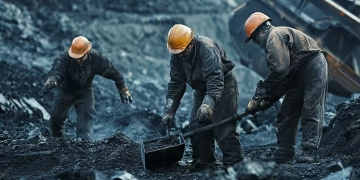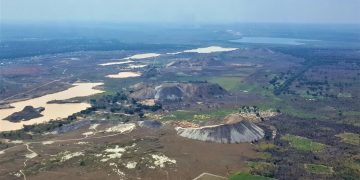

DOROTHY Mutambo, a Zimbabwean mining engineer now studying geotechnical engineering in the United States, draws on field experience at How Mine and teaching at the Zimbabwe School of Mines to examine how data, technology and safety are reshaping underground mining.
Q: Can you tell us about yourself and your journey in mining?
A: I am originally from Zimbabwe, where mining plays a central role in the economy across both large-scale and artisanal operations.
My career began at How Mine under Namib Minerals. I worked on geological data collection, drill core logging, QA/QC validation, and pit wall mapping. I was also involved in shaft sinking, blasting, and drilling engineering.
That experience exposed me to production pressures and the cost of poor data. Improving logging accuracy and validation helped strengthen decision-making on site.
I later became a lecturer at the Zimbabwe School of Mines. I supervised field investigations, trained students in ventilation and drilling and blasting, and led safety simulations.
Alongside this, I completed an MBA at NUST focused on the link between finance and technology in Zimbabwe’s artisanal mining sector. I also earned a postgraduate diploma in education and became a qualified teacher.
I am now a graduate mining engineering student at Michigan Technological University, specialising in geotechnical engineering. My work combines technical analysis with financial thinking.
Q: What are the biggest challenges in underground mining today?
A: The main challenges are increasing geotechnical complexity, rising costs, and safety risks in deeper operations.
At How Mine, I saw how geological variability and poor data affect production planning and dilution. In underground mining, weak ground characterisation increases fall-of-ground risk.
These challenges require better rock mass classification, real-time monitoring, and stronger coordination between geology and mining teams. Capital decisions must prioritise long-term risk reduction, not short-term savings.
Q: How do you see automation evolving in underground mining?
A: Automation is reducing human exposure to high-risk areas while improving consistency.
Technologies such as mechanised drilling, tele-remote load-haul-dump machines, and automated haulage systems are improving cycle times and safety.
But these systems must be financially justified. Automation should deliver clear returns through lower downtime, higher productivity, and fewer incidents. The shift will be toward semi-autonomous operations with strong human oversight.
Q: How can data analytics improve mining operations?
A: Data analytics improves forecasting, dilution control, equipment reliability, and ground support performance.
At How Mine, structured QA/QC processes improved geological confidence and reduced dilution. As a lecturer, introducing structured data workflows improved laboratory efficiency by 15%.
The most valuable data includes geotechnical monitoring, production cycle times, equipment performance, and cost metrics. When combined, these allow proactive decision-making.
Q: Can you walk us through your experience with data-driven decision-making?
A: At How Mine, I worked on validating geochemical datasets and improving logging accuracy. This reduced ore dilution by 5%.
That result showed how small improvements in data quality can directly affect profitability.
In my academic work, I use geotechnical modelling and empirical classification systems to assess excavation stability. My approach combines field data with analytical models to reduce uncertainty in design decisions.
“Small improvements in data quality can directly affect profitability.”
Q: How do you see IoT transforming mining?
A: IoT enables real-time monitoring of ground movement, equipment health, and ventilation conditions.
In underground mining, sensors can detect instability before failure occurs. This is critical for preventing incidents.
The strongest applications are predictive maintenance and integrated dashboards that link operational, geotechnical, and financial data. This shifts operations from reactive to proactive.
Q: How can AI improve mining operations?
A: AI can optimise production schedules, predict equipment failure, and improve grade control.
Machine learning can analyse historical drilling and production data to reduce dilution and improve forecasting.
Its most powerful use is in predictive safety. AI can identify patterns that precede incidents, allowing earlier intervention.
Q: What are the most significant safety risks in mining?
A: Fall-of-ground incidents remain one of the biggest risks in underground mining.
Other major risks include equipment interaction and ventilation failure.
Mitigation requires strong ground control systems, regular inspections, real-time monitoring, and disciplined safety practices. Leadership commitment is critical.
Q: How can technology improve safety?
A: Technology improves safety through proximity detection systems, tele-remote equipment, and real-time ground monitoring.
Digital tools such as stress modelling and digital twins also help engineers anticipate failure zones.
However, technology alone is not enough. It must be supported by training, accountability, and operational discipline.
Q: As a woman in a male-dominated industry, what advice would you give young women?
A: Focus on building strong technical competence first. Confidence comes from knowledge.
Find a mentor and engage consistently. Speak clearly and maintain professional standards.
Resilience and preparation build credibility. The industry benefits from diverse perspectives, and women bring strong analytical and leadership skills.
Q: How can the mining industry better support and retain women in leadership?
A: The industry needs structured mentorship programmes, clear promotion pathways, and active sponsorship.
Representation alone is not enough. Opportunities must be deliberately allocated.
During my time as a lecturer, I saw how mentorship improved both confidence and performance. Retention improves when inclusion is treated as a strategic priority, not a compliance requirement.