- ZDAMWU supports the government’s suspension of lithium and raw mineral exports.
- The union says the move aligns with local value addition goals but warns of job risks.
- ZDAMWU calls for worker protections, human rights due diligence, and unionised processing plants.
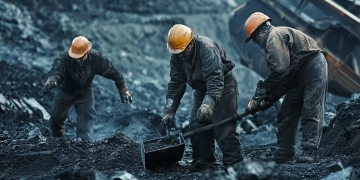
THE LARGEST mining union in Zimbabwe has expressed its support for the government’s sudden decision to suspend exports of raw minerals and lithium concentrates, saying that it is a step towards enhancing local value addition and beneficiation.
Justice Chinhema, the General Secretary of the Zimbabwe Diamond and Allied Minerals Workers Union (ZDAMWU), said that this decision aligns with broader African objectives, including the Africa Mining Vision, which aims “to anchor mineral wealth in industrialisation, decent jobs and sustainable community development.”
The suspension, which was announced by the Mines and Mining Development Ministry on February 25, is effective immediately and covers all raw minerals and lithium concentrates, even those already in transit.
“The measure has been taken in the national interest,” the ministry said, calling for the “cooperation of the mining industry” and reaffirming its commitment to promoting in-country value addition and beneficiation.
Zimbabwe, Africa’s largest lithium producer, exported approximately 1.128 million metric tonnes of lithium-bearing spodumene concentrate in 2025, mainly to China, according to official statistics.
Chinhema pointed out that this export ban could speed up the establishment of downstream processing plants, which is a key goal for the government.
“We support any initiative that advances beneficiation and creates decent jobs here at home,” he stated.
However, he cautioned that such a sudden policy change could have negative repercussions for jobs and livelihoods.
“We are concerned about the potential impact of sudden policy shifts on mine workers’ jobs, incomes and working conditions,” Chinhema added, advocating for a more consultative approach.
The union has also called for strong human rights due diligence (HRDD) standards within the critical minerals value chain, in line with the United Nations Guiding Principles on Business and Human Rights.
“All policy and investment decisions … must be guided by HRDD standards,” Chinhema insisted.
ZDAMWU is advocating for a structured social dialogue with unions regarding the timelines for implementation, transition measures, and essential safeguards to prevent job losses or unpaid layoffs.
They are also seeking assurances that any new processing plants will be unionised and adhere to labour, health, safety, and environmental regulations.
The export ban on lithium from Zimbabwe was implemented sooner than initially anticipated.
The government had previously indicated that a ban on lithium concentrate exports would take effect in 2027, but it was moved up as part of a wider initiative to address malpractices and “leakages” in the export systems.
Mines Minister Polite Kambamura told reporters that the suspension is intended to bolster local processing and accountability, stating that authorities are revising export procedures to combat irregularities.
“This review … is part of a broader effort to curb leakages and enhance efficiency within our systems,” he said.
Chinese mining companies, including Zhejiang Huayou Cobalt and Sinomine, have already made investments in processing facilities in Zimbabwe, establishing plants to convert spodumene concentrate into lithium sulphate.
Despite the hurdles, Zimbabwe’s government maintains that this policy is aimed at maximising national benefits from its mineral resources, stimulating economic growth, and promoting employment through local beneficiation.