By Jeremiah Ndhlovu
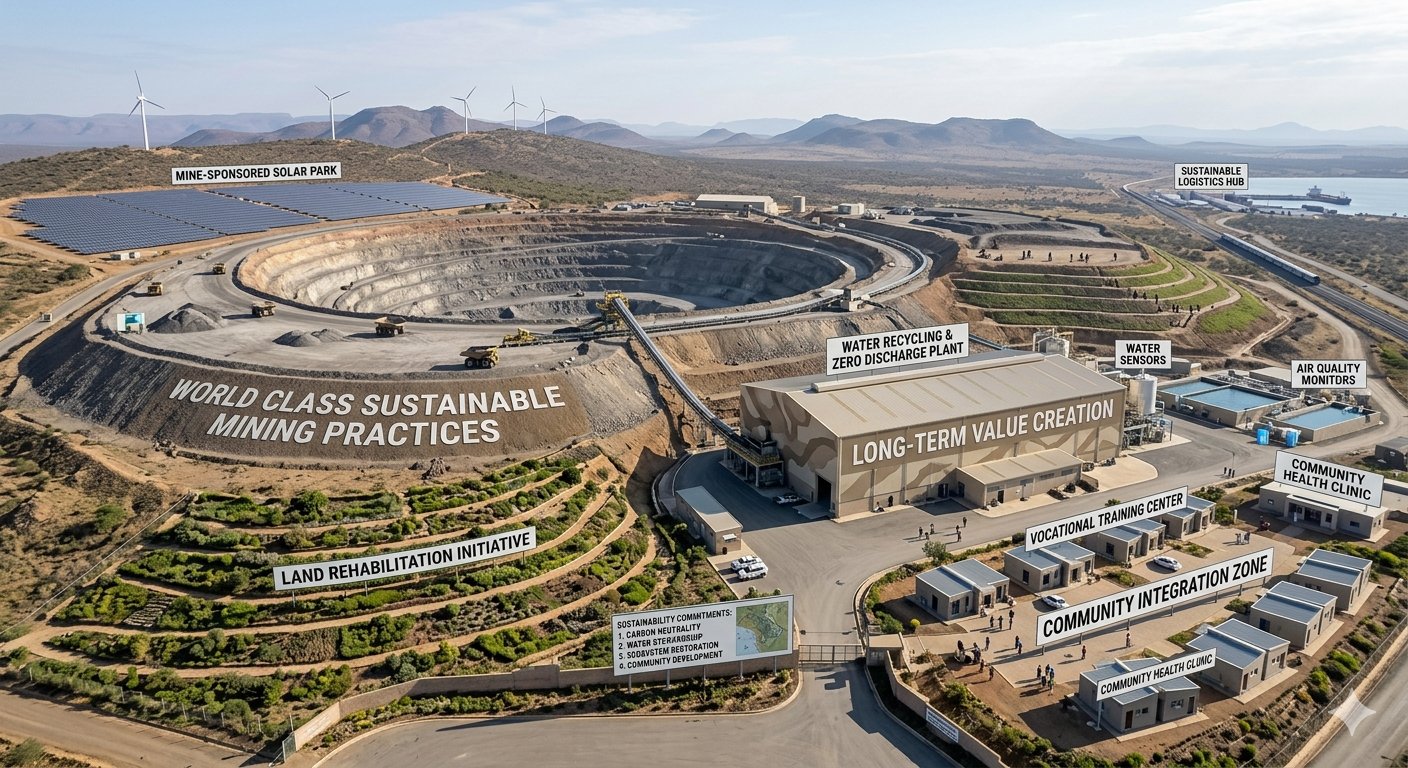
A conceptual rendering of an integrated, sustainability-led mining operation. Progressive land rehabilitation and on-site renewable generation sit alongside water-recycling and zero-discharge infrastructure, real-time environmental monitoring, and a community integration zone offering health and vocational facilities. Developments of this kind reframe a mine as a long-term engine of shared value rather than a site of extraction alone.
“The nation that destroys its soil destroys itself.”
— Franklin D. Roosevelt, Letter to State Governors, 1937
Zimbabwe sits on one of the richest and most varied mineral endowments on the African continent — lithium, gold, platinum group metals, chrome, nickel, coal, and diamonds, among other minerals. For the better part of a century, the prevailing model has been extraction-led: dig, ship, repeat. The question now facing the sector is not whether these minerals can be taken out of the ground, but whether the manner in which they are extracted creates value that endures beyond the life of the ore body itself.
Sustainability in mining is too often filed under compliance — a cost to be contained, a box to be ticked, an obligation imposed from outside. That framing is a strategic error. In practice, sustainable mining is the discipline through which a finite, non-renewable resource is converted into durable economic, social, and institutional value. The ore is depleted only once; the capabilities, infrastructure, and relationships built around it can compound for decades. This article sets out how Zimbabwean operators can treat sustainability not as a regulatory burden, but as the foundation of long-term value creation.
1. Environmental Stewardship as a Balance-Sheet Item
Mining’s environmental footprint — water drawdown, tailings, land disturbance, and energy intensity — has long been recorded as somebody else’s problem. That accounting no longer holds. Rehabilitation liabilities, carbon-pricing exposure, water-permit constraints, and the reputational discount applied by lenders and offtake partners are steadily being internalised onto the operator’s own balance sheet. Stewardship, in other words, has a price, and so does its absence.
Operators that design for closure from the first day of production — through progressive rehabilitation, dry-stack tailings, water recycling, and renewable-powered processing — convert what was once a deferred and uncertain liability into a defensible, financeable asset. In a country where energy supply is constrained and water is contested, environmental discipline is not philanthropy. It is operational resilience, and increasingly it is a precondition for access to capital.
2. The Social Licence to Operate
No permit issued in Zimbabwe substitutes for the consent of the community that lives alongside the mine. Existing research in Zimbabwe’s mining districts records persistent dissatisfaction: a clear majority of community members feel their input is disregarded, air and water pollution rank among their foremost concerns, and only a minority rate local development outcomes as adequate. These sentiments are not background noise. They are leading indicators of permitting delays, work stoppages, and the slow erosion of the trust on which long-term operations depend.
A social licence cannot be purchased retrospectively once relations have soured. It is built through a genuine shared-value model: local procurement and employment, structured skills transfer, transparent community development agreements, and consultation that informs decisions rather than merely announcing them. Where communities perceive that they share in the value created, the asset becomes more secure — and that security is itself a form of value.
3. Governance, Transparency, and the ESG Premium
Capital is no longer indifferent to how it is deployed. Development finance institutions, listed-equity investors, and international offtake partners now screen environmental, social, and governance (ESG) performance as a condition of access, not a courtesy. For Zimbabwean operators, credible governance — Board-level oversight of sustainability, reliable disclosure, and robust anti-corruption controls — is what unlocks the cost-of-capital advantage that competitors with weaker controls cannot reach.
Transparency compounds this advantage. Participation in recognised reporting frameworks, clear beneficial-ownership records, and consistent application of permit and royalty rules reduce the perceived country risk that has long inflated the discount rate applied to Zimbabwean assets. Good governance is not a constraint on returns; it is the mechanism through which returns are made bankable.
4. From Extraction to Beneficiation and Circularity
The national beneficiation agenda — retaining and processing minerals domestically rather than exporting them raw — is, at its core, a value-creation strategy. Each step of in-country processing captures margin, builds industrial skills, and deepens the linkages between mining and the wider economy. Sustainable value creation extends this logic further: recovering saleable by-products, reprocessing legacy tailing dumps with modern technology, and designing material flows so that yesterday’s waste becomes tomorrow’s feedstock. A circular approach lengthens the productive life of every tonne moved and softens the sector’s exposure to volatile single-commodity cycles.
This matters most for Zimbabwe’s lithium, where global demand is tied to the energy transition and where buyers increasingly demand a verifiable origin for the materials they purchase. An operator that can demonstrate responsible water use, traceable supply chains, and credible carbon performance does not merely comply with the market — it commands a premium within it. Sustainability and competitiveness, in this light, are not opposing forces to be traded off against one another. Over any horizon that matters, they are the same thing.
5. A Practical Path to Sustainable Value
Translating principle into practice requires deliberate sequencing rather than aspiration. Operators are encouraged to prioritise four actions:
• Embed closure from the outset. Build progressive rehabilitation, tailings stewardship, and water management into the mine plan and the cost model from day one — not as an end-of-life afterthought.
• Formalise the community compact. Establish transparent community development agreements with measurable commitments, and consult in a way that genuinely shapes decisions and builds durable trust.
• Make ESG reporting credible. Place sustainability under explicit Board oversight and report against a recognised framework, so that performance is visible to the financiers and partners who price it.
• Invest in resilience. Develop energy, water, and skills capacity that de-risks operations and positions the business for beneficiation and circular value capture over the long term.
6. Conclusion
Zimbabwe’s mineral wealth is finite. The value it creates need not be. The operators who will prosper over the coming decades are those who treat sustainability not as a cost imposed upon them, but as the strategy through which a depleting resource is transformed into lasting capability, infrastructure, and trust. That reframing — from extraction to stewardship, from compliance to value creation — is the work of the present, not the future.
An ore body is exhausted in a matter of decades. The skills, institutions, and goodwill built around it can endure far longer — but only if they are built deliberately, and built now.
ABOUT THE AUTHOR
Jeremiah Ndhlovu is the Managing Partner at Gallo Advisory, a firm he co-founded to deliver senior governance, risk, and compliance (GRC) expertise across Sub-Saharan Africa. He is a Chartered Accountant (Zimbabwe) and a Certified Expert in Risk Management (CERM), with over seventeen years of experience spanning GRC advisory, internal audit, external audit, and financial leadership.
His career has taken him from the audit floors of EY, working across seven African countries, to the boardrooms of some of Zimbabwe’s largest diversified groups, where he served as Group Chief Audit Executive. At Gallo Advisory, he works with clients across corporate restructuring, capital raising, ERP implementation, as well as internal audit and risk management transformation.
This article reflects his professional perspective, informed by engagements across Zimbabwe and the broader SADC region. It is for information purposes only.