
ZiMining
  • News
    • Breaking News
    • Editor’s Picks
    • Company News
    • Exploration & Discovery
    • Production & Operations
    • Zimbabwe
    • Global
  • Commodities
    • Gold
    • Copper
    • Lithium
    • Critical Minerals
    • Platinum Group Metals
    • Diamonds
    • Coal
  • Regions
    • Zimbabwe
    • Southern Africa
    • West Africa
    • East Africa
    • Central Africa
    • Global
  • Markets
    • Prices & Data
    • Mining Stocks
    • Companies
    • M&A & Deals
    • Finance & Investment
    • Junior Miners
  • Technology
    • Innovation & Technology
    • Automation & Robotics
    • AI & Data Analytics
    • Digital Mining
    • Equipment & Machinery
    • Safety Technology
  • Sustainability
    • Environment & Climate
    • Community Impact
    • ESG & Reporting
    • Decarbonisation
    • Water & Land Use
    • Women in Mining
  • Policy
    • Government & Regulation
    • Government & Policy Makers
    • Legislation & Compliance
    • Trade, Tax & Royalties
    • Risk Management
    • Artisanal & Small-Scale Mining
  • Insights
    • Editorials
    • Contributors
    • Commentary & Analysis
    • Blasted Zone
    • Industry Leaders
    • Special Reports
    • ZiMining Magazine
    • Events & Conferences
    • Research & Reports
  • News
    • Breaking News
    • Editor’s Picks
    • Company News
    • Exploration & Discovery
    • Production & Operations
    • Zimbabwe
    • Global
  • Commodities
    • Gold
    • Copper
    • Lithium
    • Critical Minerals
    • Platinum Group Metals
    • Diamonds
    • Coal
  • Regions
    • Zimbabwe
    • Southern Africa
    • West Africa
    • East Africa
    • Central Africa
    • Global
  • Markets
    • Prices & Data
    • Mining Stocks
    • Companies
    • M&A & Deals
    • Finance & Investment
    • Junior Miners
  • Technology
    • Innovation & Technology
    • Automation & Robotics
    • AI & Data Analytics
    • Digital Mining
    • Equipment & Machinery
    • Safety Technology
  • Sustainability
    • Environment & Climate
    • Community Impact
    • ESG & Reporting
    • Decarbonisation
    • Water & Land Use
    • Women in Mining
  • Policy
    • Government & Regulation
    • Government & Policy Makers
    • Legislation & Compliance
    • Trade, Tax & Royalties
    • Risk Management
    • Artisanal & Small-Scale Mining
  • Insights
    • Editorials
    • Contributors
    • Commentary & Analysis
    • Blasted Zone
    • Industry Leaders
    • Special Reports
    • ZiMining Magazine
    • Events & Conferences
    • Research & Reports
No Result
View All Result
ZiMining
No Result
View All Result
Home Opinions Commentary & Analysis

The execution gap costing miners and their investors billions

Mining firms keep missing targets as operational debt mounts, with capability gaps costing billions despite new technology and restructuring efforts

Alex Franklin by Alex Franklin
May 29, 2026
in Commentary & Analysis, Innovation & Technology, Production & Operations, Risk Management
Reading Time: 5 mins read
1
A A
0
Split‑view showing corporate boardroom with executives and an active mine site with workers and machinery.

Executives review production charts during a meeting at company headquarters as miners work at an open‑pit site. The image highlights the gap between boardroom expectations and on‑site realities. (Photo illustration by ZiMining)

44
VIEWS
Share on LinkedinShare on XShare on Facebook
  • Accenture says miners often miss guidance despite heavy investment.
  • McKinsey reports productivity is 25% lower than in 2005.
  • Improving operational capability can lift output 24–37% without added cost.

DESPITE an all-out effort in the last few weeks, there’s no escaping the results. Another quarter, another miss.

The site leadership team is unsurprised. To them it felt like they were already starting on the back foot, having just gone through this the quarter before. Everyone outside the site boundary sees only one thing: missed guidance.

The Execution Gap is the void between what a company’s leadership expects and what a site can actually deliver.

The numbers are telling. Between 2020 and 2024, Accenture found that globally 61% of mining companies reported results at, or below the lower half of their own guidance. Mining companies are setting their own targets and failing to hit them.

According to the study, the cumulative cost was $64 billion in lost forecast revenue.

The gap is not a failure of any one thing: the people, geology, or technology. It is a structural one, and the instinct to fix it with the usual responses is only making it worse.

The productivity paradox

McKinsey found that mine productivity is 25% lower in 2025 than it was 20 years ago in 2005. This is after controlling for declining ore grades and increasing depth.

The industry has spent two decades buying better equipment, better software, and better systems. In short, miners are spending more to get the same amount out.

How is that possible?

Many sites have been quietly accumulating Operational Debt, often masked by high or rising commodity prices. This debt, the deferred maintenance, the burnt‑out crews, the workarounds that become standard practice, the chasing higher grade faces, becomes a compounding loan against future production reliability.

Unlike its financial equivalents, Operational Debt doesn’t show up on any balance sheet or P&L. It only appears when it’s too late, as missed targets and quarters.

As a result, the urgency to address the systemic cause is never quite high enough. Leaders are forced to manage the crisis in front of them.

Nothing really changes.

The silver bullet trap

When production falls short and pressure builds, the response is almost always the same. A technology platform gets approved. There’s an org chart shake-up. Or perhaps a consultant is engaged to implement whichever management practice is currently in vogue.

I call these Silver Bullets, and in mining they can be thought of in four categories:

  • Technological: buying software, A.I. solutions, tablets, or dashboards
  • Asset: investing in new equipment, sites, or upgrading existing plant
  • Methodological: consultant-led improvement and cost-cutting programs
  • Inspirational: sending leaders to offsite training, usually with zero accountability for implementing and developing their learnings

These solutions are not inherently wrong. Technology can be a force multiplier. Strong, coherent leadership matters.

You need the big yellow toys to move material and a single source of truth when it comes to data. The problem is they are deployed as standalone, isolated interventions into a broken system.

They treat symptoms rather than the root cause. It’s no wonder they consistently fail to deliver the promised results, often becoming expensive shelf-ware.

Ultimately, layering any of these “solutions” over a broken system doesn’t fix it. It simply scales the dysfunction, cost, and inefficiency.

To make matters worse, PROSCI reports that mining has a poor history of Change Management. This is backed up by data from Ernst & Young showing that 74% of mining and metals executives identify technology integration as a key challenge.

Across other industries, that figure is only 37%. In other words, miners are twice as likely to struggle to implement the very solutions they keep reaching for.

The board can’t see what the GM can

In 1989, consultant Sidney Yoshida introduced the Iceberg of Ignorance. His research found that top executives, the decision makers, are aware of only 4% of frontline problems. Middle managers know 9%. Supervisors know 74%.

The people doing the work know 100%.
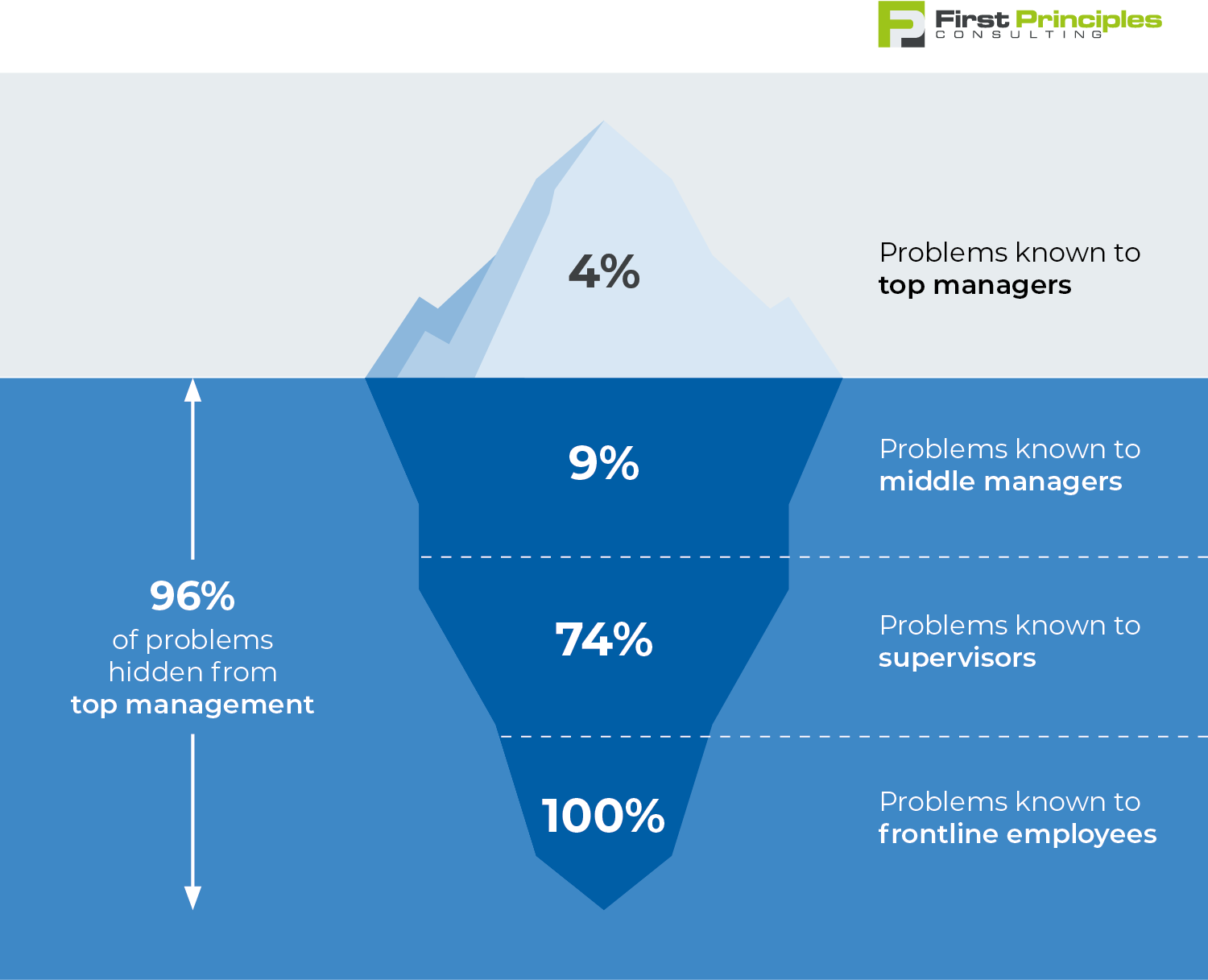
Iceberg diagram showing how awareness of problems decreases from frontline workers to top managers.
An iceberg diagram illustrates the “Iceberg of Ignorance,” showing how 96% of operational problems remain hidden from top management. (Image: First Principles Consulting.)

Everyone on site has lived the experience where operations are “sanitised” for visits from head office, investors, or potential buyers.

How does a board make the right call with 4% of the picture? It can’t.

The decisions being made at board level, on targets, capital allocation, and strategy, rely on a version of reality the site team would barely recognise.The site leadership team knows which targets are achievable and which aren’t.

But there is no feedback loop to communicate that knowledge upward without it sounding like excuses. With no other option, site leaders nod and agree to push harder next quarter, accumulating more Operational Debt.

The invisible engine

What separates a mine that consistently and sustainably hits its aspirational targets from one that doesn’t? The answer is Operational Capability.

This is the integrated system of tangible and intangible assets that determines whether a site can reliably convert strategic ambition into operational results. I describe it as the Invisible Engine: the system underneath the system, the confluence of leadership, culture, data, technology, and processes.

Operational Capability is objective and can be measured. We created the Capability Curve to map a site’s maturity from Innocence to Excellence, identifying precisely where the friction sits and what closing it is worth.

The best part for site leaders is that when the level is known, so too is the solution. It doesn’t require experimentation, silver bullets, or the reinventing of the wheel that we typically see.
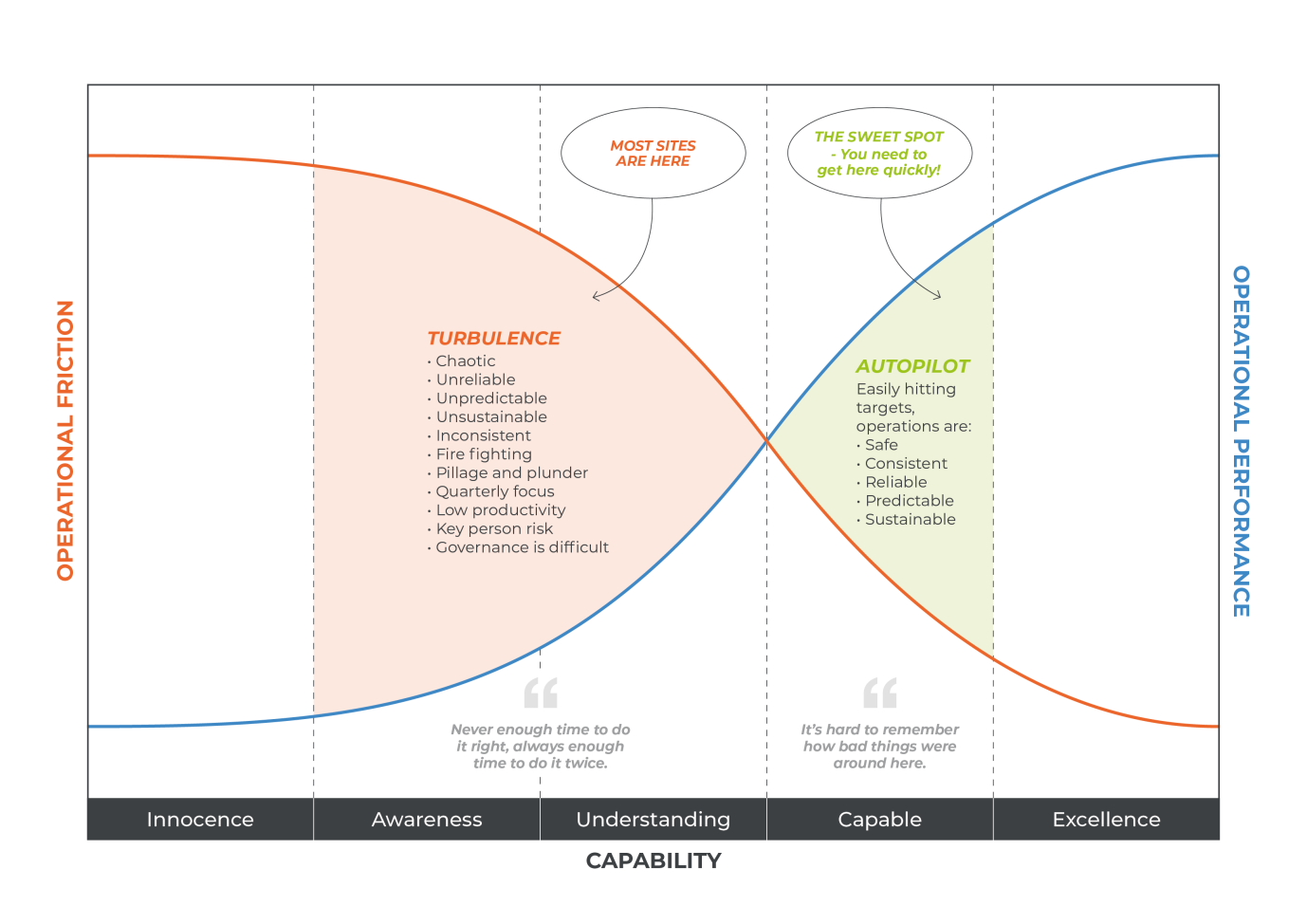
Diagram showing how increasing operational capability reduces turbulence and increases performance.
A Capability Curve diagram illustrates how higher operational capability reduces friction and boosts performance, shifting mines from turbulence to autopilot. (Image: First Principles Consulting.)
  • When Operational Capability is low, sites exist in the Turbulence Zone, permanently firefighting, reliant on heroics, trapped in reactive management.Every quarter is uncertain. Hitting every target increases operational debt through practices such as sterilised mining faces caused by chasing high grade or metal scoured from processing circuits.


  • When Operational Capability is high, sites operate in the Autopilot Zone. Hitting targets becomes routine. Some clients describe it as almost boring.Processes and technology just work. Silos have been busted wide open.When things inevitably go wrong, often because of external shocks like force majeure or supply chain disruption, the Invisible Engine responds calmly and rationally rather than reacting in panic.


The Execution Gap exists because decision makers are creating plans based on a site in the Autopilot Zone when the site is actually operating in the Turbulence Zone. This is what’s costing the industry and its investors billions.

The good news is that we’ve consistently found that improving the Invisible Engine, moving a site up the operational maturity curve, produces an initial sustainable production increase of 24–37% without increasing fixed costs.

That is the latent capacity that exists in most sites.

The conversation that needs to happen

Deloitte projects a shortage of 2.7 million skilled mining workers globally by 2030. Junior engineers are being placed into senior roles with a shorter experience on-ramp than those positions historically required.

The knowledge needed to build Operational Capability on sites is eroding at the exact moment it is most needed. The window to act is limited.

The gap between what a mine is capable of producing and what it actually produces is not a secret. Everyone on site knows it.

Just look at the variability between the best and worst production days, when everything goes right or wrong.

The question is whether anyone above site level is willing to hear it, and whether the site leadership team has the language and data to make them listen.

That language starts with making the invisible visible. Highlighting the distance between ambition and operational reality. Not as an excuse, but as a diagnosis.

The Execution Gap doesn’t close with more capital, A.I., or heroics. It closes when organisations stop treating operational failures as surface problems and start building the operational capability required to deliver their strategy.

Mining companies only need to develop this once and roll it out across all their sites. That is where the real value in mining has always been.

Not what’s in the ground, but the capability to consistently extract it at scale.
 

Tags: Execution gapLeadership & strategyMining productivitOperational capabilityRisk managementy
Alex Franklin

Alex Franklin

Alex Franklin is a Chartered Engineer and Managing Director at First Principles Consulting. He is the author of Mining For Value: A Blueprint to Eliminate Chaos, Scale Production, and Unlock Latent Capacity. Franklin combines global, cross‑sector expertise with a value investor’s mindset to bridge the gap between the boardroom and the blast site. His focus is on shifting mining from reactive to proactive, minimising operational risk rather than just managing it, and driving resilient growth while reducing value left on the table.

Related Posts

Haul truck transporting copper ore at Kansanshi mine in Zambia.
Copper

DRC and Zambia rank among world’s top copper holders as demand rises

by ZiMining
April 25, 2026
Open‑pit mine with excavators and lithium processing plant.
Lithium

Zimbabwe tightens grip on lithium exports, demands local processing push

by ZiMining
April 8, 2026
Legal expert explaining contract details to a client in an office
Risk Management

Compliance is costly until it isn’t

by Jeremiah Ndhlovu
April 6, 2026
Next Post
Douglas Zimbango, outgoing ZCDC chief executive officer

Zimbabwe's state diamond miner names industry veteran Mtombeni as CEO

Leave a Reply Cancel reply

Your email address will not be published. Required fields are marked *

I agree to the Terms & Conditions and Privacy Policy.

Search ZiMining

No Result
View All Result

Most Read

  • Zimbabwe Mines Minister Polite Kambamura seated at a desk with the national flag behind him.

    Zimbabwe suspends raw mineral, lithium concentrate exports with immediate effect

    0 shares
    Share 0 Tweet 0
  • Goriwondo advocates engineer-led reforms at ZIE leadership

    0 shares
    Share 0 Tweet 0
  • Retrenched diamond workers ask state to recover unpaid pensions

    0 shares
    Share 0 Tweet 0
  • Union backs lithium export halt, calls for worker protections

    0 shares
    Share 0 Tweet 0
  • IMPACT hires communications lead for planetGOLD Zimbabwe project

    0 shares
    Share 0 Tweet 0

Latest from ZiMining

Douglas Zimbango, outgoing ZCDC chief executive officer

Zimbabwe’s state diamond miner names industry veteran Mtombeni as CEO

May 29, 2026
Split‑view showing corporate boardroom with executives and an active mine site with workers and machinery.

The execution gap costing miners and their investors billions

May 29, 2026
Freda Rebecca Mine infrastructure in Bindura, Zimbabwe.

Mutapa Gold Resources CEO Barnard resigns, Shayawabaya named successor

May 2, 2026
Mine workers in Zimbabwe listen to union officials during a gathering.

Zimbabwe mine union demands $650 minimum wage, stronger safety rules

May 2, 2026
Dr. Thomas Utete Wushe, newly appointed Permanent Secretary for Mines and Mining Development, in a formal portrait.

Wushe takes Mines portfolio in Mnangagwa reshuffle

May 2, 2026
ZiMining


ZiMining is an independent mining and natural resources news platform based in Zimbabwe, with a focus on Zimbabwe, Africa and global markets. We provide factual, balanced and industry-driven reporting on mining, energy, sustainability, policy and commodities.


Categories

  • Africa
  • AI & Data Analytics
  • Archive
  • Artisanal & Small-Scale Mining
  • Automation & Robotics
  • Blasted Zone
  • Breaking News
  • Central Africa
  • Coal
  • Commentary & Analysis
  • Commodities
  • Community Impact
  • Community Voices
  • Companies
  • Companies
  • Company News
  • Contributors
  • Copper
  • Critical Minerals
  • Decarbonisation
  • Diamonds
  • Digital Mining
  • East Africa
  • Environment & Climate
  • Equipment & Machinery
  • Events & Conferences
  • Exploration & Discovery
  • Features
  • Finance & Investment
  • Global
  • Gold
  • Gold
  • Government & Policy Makers
  • Government & Regulation
  • Industry Leaders
  • Innovation & Technology
  • Interviews
  • Junior Miners
  • Latest Edition
  • Legislation & Compliance
  • Lithium
  • M&A & Deals
  • News
  • Opinions
  • Platinum Group Metals
  • Production & Operations
  • Risk Management
  • Safety Technology
  • Southern Africa
  • Special Reports
  • Sustainability
  • Trade, Tax & Royalties
  • Water & Land Use
  • West Africa
  • Women in Mining
  • Zimbabwe

Got a Story?

Have a news tip, document or story idea related to mining, energy, policy or governance?
Email us at

editor@zimining.co.zw


About ZiMining


Contact & Advertise

Recent Posts

  • Zimbabwe’s state diamond miner names industry veteran Mtombeni as CEO
  • The execution gap costing miners and their investors billions
  • Mutapa Gold Resources CEO Barnard resigns, Shayawabaya named successor

© 2025 ZiMining - Exclusively Mining | Privacy Policy | Terms & Conditions

Welcome Back!

Login to your account below

Forgotten Password?

Retrieve your password

Please enter your username or email address to reset your password.

Log In
ZiMining Donation Banner
ZiMining

News without an agenda.

ZiMining is an independent publication with no corporate parent, no shareholders and no government influence. Our mission is journalism, not profit margins. Your donation supports independent reporting that serves the mining industry across Africa.

ZiMining Sliding Donation Card
No Result
View All Result
  • News
    • Breaking News
    • Editor’s Picks
    • Company News
    • Exploration & Discovery
    • Production & Operations
    • Zimbabwe
    • Global
  • Commodities
    • Gold
    • Copper
    • Lithium
    • Critical Minerals
    • Platinum Group Metals
    • Diamonds
    • Coal
  • Regions
    • Zimbabwe
    • Southern Africa
    • West Africa
    • East Africa
    • Central Africa
    • Global
  • Markets
    • Prices & Data
    • Mining Stocks
    • Companies
    • M&A & Deals
    • Finance & Investment
    • Junior Miners
  • Technology
    • Innovation & Technology
    • Automation & Robotics
    • AI & Data Analytics
    • Digital Mining
    • Equipment & Machinery
    • Safety Technology
  • Sustainability
    • Environment & Climate
    • Community Impact
    • ESG & Reporting
    • Decarbonisation
    • Water & Land Use
    • Women in Mining
  • Policy
    • Government & Regulation
    • Government & Policy Makers
    • Legislation & Compliance
    • Trade, Tax & Royalties
    • Risk Management
    • Artisanal & Small-Scale Mining
  • Insights
    • Editorials
    • Contributors
    • Commentary & Analysis
    • Blasted Zone
    • Industry Leaders
    • Special Reports
    • ZiMining Magazine
    • Events & Conferences
    • Research & Reports

© 2025 ZiMining - Exclusively Mining | Privacy Policy | Terms & Conditions

This website uses cookies. By continuing to use this website you are giving consent to cookies being used. Visit our Privacy and Cookie Policy.
Are you sure want to unlock this post?
Unlock left : 0
Are you sure want to cancel subscription?