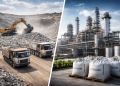
- Subcontracting offers mines flexibility, expertise, and reduced capital burden.
- In-house drilling and blasting gives full control, integration, and long-term cost efficiency.
- The right choice depends on mine size, geology, capital, and production horizon.
THE DECISION to subcontract drilling and blasting is one of the most important choices in modern mining. It shapes cost, control, risk, and long-term efficiency.
Mines face a clear choice. Outsource for flexibility and specialised expertise, or keep operations in-house for control and integration.
At its core, the decision is financial. It is a choice between upfront capital investment and predictable operating cost.
The case for subcontracting
For many mines, subcontracting is a strategic move to access expertise.
It provides immediate access to skilled engineers, advanced blast design, and modern drilling technology. This is especially valuable for small-to-mid-sized operations or mines with complex geology.
Responsibility also shifts.
The contractor handles regulatory compliance, permits, explosive handling, and crew safety. This reduces the operational burden on the mine.
Financially, subcontracting converts large CAPEX into more predictable OPEX. This improves cash flow and preserves capital for other priorities.
It also brings flexibility.
Mines can scale blasting activity up or down in line with production demand. There is no need to maintain a permanent, specialised workforce.
But flexibility comes at a cost.
The case for in-house operations
Large, long-life mines often favour in-house drilling and blasting.
This approach offers full control over a critical production function. Blasting schedules can align precisely with loading, hauling, and crushing. This helps avoid costly production delays.
Control also improves integration.
All data on rock conditions and blast performance feeds directly into internal geological and planning systems. This supports continuous optimisation.
While this model requires significant CAPEX, the long-term cost can be lower. High-volume operations avoid paying contractor margins over many years.
It also removes dependence on external providers.
All teams work toward the same goal. Total cost efficiency across the entire operation, not just the blast itself.
Control, however, demands commitment.
What determines the right model
There is no single answer. The right model depends on the mine’s context.
Key questions include:
- How long will the mine operate?
- How complex is the geology?
- Is sufficient capital available?
- Does management view drilling and blasting as a core function?
Short-life or capital-constrained projects often favour subcontracting.
Large, stable operations with long horizons tend to invest in in-house capability.
In practice, many mines adopt a hybrid model.
The Zimbabwe reality
Zimbabwe’s drilling and blasting sector reflects this mix.
Full-service contractors include T&A Drilling and Blasting, KW Blasting, RAM, Tandamanzi, and Shaft Sinkers Zimbabwe.
Specialists such as AECI Mining, Intrachem, and Solar Explosives focus on blasting services and explosives supply.
Different mines apply different models.
Some operations, such as Eureka Gold Mine and Zimplats South Pit, rely heavily on subcontracting.
Others use hybrid structures. At sites like ZCDC and Zhong Jian coal mines, drilling may be done in-house while blasting is outsourced.
Underground operations, including Blanket Mine, How Mine, Mimosa, and Unki, often retain full internal control.
The bottom line
The drilling and blasting dilemma is not about finding a universal answer.
It is about making a deliberate choice.
Subcontracting offers flexibility and access to expertise.
In-house operations offer control and integration.
The advantage lies in choosing the model that fits the mine’s scale, resources, and long-term goals for safe and efficient production.