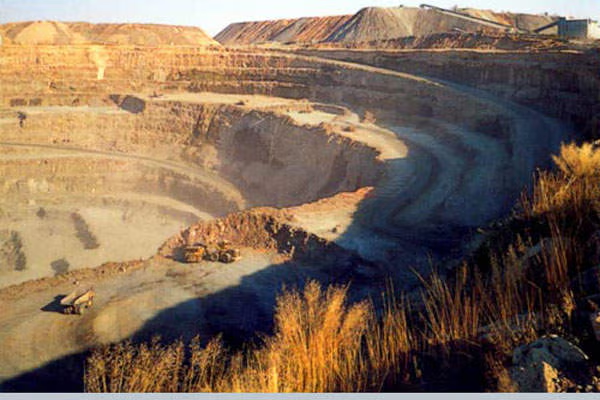
- De Beers reported a $511 million loss as global demand for diamonds weakened.
- Lower buying from China and economic uncertainty reduced sales across key markets.
- The downturn is raising concerns for diamond-producing countries that depend on mining revenue.
DE BEERS has reported a staggering loss of $511 million for 2025, a significant drop from the $25 million loss recorded the previous year.
This downturn has been largely attributed to weak demand from China and declining rough diamond prices, which have severely affected sales.
According to the annual results from the company’s parent, Anglo American, revenue has plummeted to $3.5 billion, down from $4.3 billion in 2024.
Rough diamond production has also taken a hit, falling by 12% to 21.7 million carats. This is about 3 million carats less than the year before as the group scaled back output to align with the softer demand.
Chief Executive Al Cook noted that this downturn is a result of “a prolonged slowdown in China and continued cautious buying in the midstream.”
Historically, China has been one of the largest markets for diamond jewellery globally, but a property crisis coupled with slower economic growth has dampened luxury spending.
Bain & Company’s latest Global Diamond Report indicates that global demand for diamond jewellery fell in 2024, with Chinese consumption remaining lacklustre.
Analysts have pointed out that this slump has led to high inventories throughout the polishing and trading pipeline.
“Demand recovery has been slower than expected, particularly in China,” said Paul Zimnisky, an independent diamond industry analyst. “Producers have had to adjust supply to stabilise the market.”
On top of weak demand, diamond miners are also facing increasing competition from lab-grown stones, which have been gaining traction in the United States, the largest market for bridal jewellery.
Bain estimates that lab-grown diamonds now represent more than 15% of global diamond jewellery sales by value, marking a structural shift that has put additional pressure on the prices of natural stones.
Furthermore, trade uncertainty has cast a shadow over the industry.
Executives have cautioned that proposed U.S. tariffs on luxury goods and jewellery imports could disrupt global supply chains, although no widespread tariffs on rough diamonds have been put into effect.
The downturn comes as Anglo American takes a closer look at its portfolio and gears up to either spin off or sell De Beers as part of a wider restructuring effort.
The miner revealed plans in 2024 to streamline its operations and concentrate on copper and iron ore.
Analysts suggest that selling during a period of weak pricing could prove to be quite tricky.
“Timing will be critical,” noted Ben Davis, a mining analyst at Liberum. “The diamond market is cyclical, and buyers will take current conditions into account when determining value.”
Botswana, which depends on diamonds for about a third of its government revenue and the majority of its export earnings, is working to gain more control over marketing through its state-owned Okavango Diamond Company.
The Bank of Botswana has cautioned that declining diamond sales have impacted fiscal revenues and economic growth.
Smaller producers are also tightening their belts and postponing expansion projects as financing becomes increasingly difficult to secure.
Industry representatives believe that recovery depends on consumer confidence in China and the reduction of inventory in major trading centres like India and Belgium.
“There is long-term demand for natural diamonds,” Cook said. “But the market needs time to find its balance.”
Diamonds continue to be a vital source of foreign exchange for Botswana, Namibia, and South Africa, making price stability essential for fiscal planning throughout the region.