- EIA says Congo’s 30k cobalt plant is causing illness and displacement.
- BMW and Mercedes are linked through supply chains; Stellantis, maker of Jeep and Peugeot, is also named.
- Government action is unclear; CMOC continues operating as audits proceed.
ON a humid evening in Fungurume, in the Democratic Republic of Congo, the sour taste of gas hung in the air.
Residents of Manomapia say they could feel it burning their throats, leaving children coughing up blood and mothers fearing for their pregnancies.
“This death was caused by air pollution,” one grieving family told investigators.
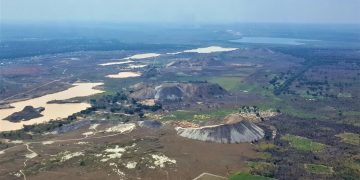
Their neighbourhood sits just beyond the walls of Tenke Fungurume Mining’s new “30k” plant, a copper-cobalt processing facility the size of 500 soccer fields.
In a report seen by ZiMining, the Environmental Investigation Agency (EIA), in its 2026 publication Toxic Transition: How the World’s Largest Cobalt Producer Has Allegedly Poisoned Communities for Years, links this expansion to a public health crisis that has spread across the town, even as global car makers continue to rely on its cobalt for electric vehicle batteries.
Manomapia is a working-class neighbourhood in Lualaba Province. Most residents are small-scale farmers, traders, or mine workers. Families live in modest homes built close to the plant’s perimeter.
Local leaders told EIA that many households survive on less than $5 a day. “We are poor people living next to a giant mine,” said a community elder. “We cannot move away, and now our children are sick.”
Medical records analysed by EIA show more than 1,200 cases of respiratory illness since 2023. Doctors reported pneumonia, bronchitis, and haemoptysis. Children were the first to suffer.

By late 2023, pediatricians documented repeated nosebleeds and persistent coughs among young patients. Pregnant women reported complications, including stillbirths.
“We saw a rise in maternal health problems after the plant began operating,” said a nurse at a local clinic. “The link to pollution is clear to us.”
Residents say the crisis began soon after the 30k plant opened in 2023.
“Before, we had dust and smoke, but nothing like this,” said a mother of three. “Now the air burns our eyes and throats.”
Independent air monitoring commissioned by EIA between September 2024 and January 2025 found sulfur dioxide levels well above international standards.
“Exposure to sulfur dioxide at these levels is dangerous, especially for children and pregnant women,” said one toxicology expert.
Workers at the mine corroborated the findings.
“Periodic off-gassing of SO₂ was not a secret,” one told investigators.
Alarms were ignored because restarting machinery would take too long.
“I saw three men collapse when the gas built up,” another worker said.
These accounts appear to contradict Congolese law, which enshrines the right to breathe air “not harmful to health.”
Tenke Fungurume Mining (TMF), a subsidiary of Chinese giant CMOC Group Ltd, disputes the allegations.
In its response, the company said monitoring data collected in late 2024 and early 2025 showed ambient SO₂ concentrations within regulatory limits.
“Allegations suggesting a direct causal link between TFM’s expansion and health impacts in Manomapia are not supported by the monitoring data and assessments available to TFM,” the company stated.
Regulatory oversight in Congo is weak.
“The law is clear, but implementation is poor,” said a lawyer in Lubumbashi. “Companies often self-report, and the government does not have the capacity to verify.”
This gap explains why TFM’s data show compliance while EIA’s findings indicate severe pollution.
“Company monitors may be placed in areas less exposed,” said an environmental auditor. “EIA’s monitors were closer to communities.”
EIA estimates that 12,000 people have been displaced since 2022, across Kabombwa, Kalweji, and Manomapia.
“We were told to leave without proper consultation,” said a displaced farmer. “We lost our land and our homes.”

Many now live in temporary settlements with limited access to water and schools.
“Families are struggling to rebuild their lives,” said a social worker. “Support is minimal.”
Stellantis, parent of Peugeot, Jeep, and Fiat, acknowledged these reports.
“Audits by our third-party partner have identified reported cases of relocation of individuals in the Manomapia area,” the company said.
“We will continue to follow up with TFM to understand the progress of mitigation efforts,” Stellantis added.
Umicore, a Belgian materials technology company supplying cathode materials for EV batteries, said: “We have not been able to establish a clear, evidence-based causal link between TFM’s operations and specific health or environmental impacts.”
Mercedes-Benz confirmed it had initiated an incident management process after receiving EIA’s study results in November 2025.
“Our review did not indicate shortcomings related to SO₂ emissions,” the company stated.
BMW distanced itself, saying: “Currently, the BMW Group does not have a direct supply relationship with TFM for either copper or cobalt related products.”
The company stressed that its direct sourcing excludes cobalt from DRC, though it acknowledged indirect links through suppliers.
BMW pointed to its involvement in IRMA and its “Cobalt for Development” project with GIZ, aimed at transforming artisanal mining in the DRC.
The Copper Mark certified TFM in June 2024 as “fully meets” all 31 criteria.
EIA’s findings contradict those conclusions.
“We have seen cases where audits missed serious violations,” said a mining governance specialist. “Independent oversight is essential.”
TFM is now undergoing assessment by the Initiative for Responsible Mining Assurance (IRMA).
Mercedes-Benz, a member of IRMA’s board, said it was following the process closely.
EIA has called for a multi-stakeholder body to accompany the audit, with full access to information and representation from civil society.
Electric vehicle sales hit 17.5 million units in 2024, rising to 18.5 million in 2025.
Global cobalt demand exceeded 200,000 tons in 2024.
CMOC’s share of global production surged from 10% in 2020 to 40 percent in 2024.
Its aggressive expansion created a glut, driving cobalt prices down from $100,000 per ton in 2018 to under $20,000 in 2025.
“Consumers want clean cars, not dirty supply chains,” said a consumer advocate. “Trust in the EV industry is at stake.”
International organisations are watching.
“This is a test case for responsible sourcing,” said RAID, a UK watchdog.
“We cannot allow green technology to be built on toxic foundations,” said an EU official.
EIA’s recommendations are blunt. It urged the DRC government to investigate alleged violations, make the crisis a national priority, and establish independent monitoring.
To CMOC, EIA called for suspension of the 30k plant until preventive systems are in place, disclose SO₂ data publicly, and establish reparations.
Automakers were encouraged to suspend purchases from TFM until independent verification of emissions, support community-led monitoring, and disclose cobalt sourcing to the mine of origin.
To IRMA, the report recommended that it establishes an independent multi-stakeholder body with full access to audit information and corrective measures.
The next steps are uncertain, and the DRC government has not announced concrete action. CMOC continues to operate, while automakers say they are monitoring. IRMA’s audit is ongoing.
“We want clean air and justice,” said a resident of Manomapia. “We cannot keep suffering while the world drives electric cars.”
Disclaimer: All the quotes in this story come from the Environmental Investigation Agency’s Toxic Transition report (2026) or from official company statements sent to the Agency. In the report, some people, like residents, workers, and medical staff, are not named. This is because the investigators kept their identities private to protect them. ZiMining has not added or made up any quotes.