New! The ZiMining August 2026 issue is here. Download your free copy
ZiMining
  • News
    • Breaking News
    • Editor’s Picks
    • Company News
    • Exploration & Discovery
    • Production & Operations
    • Zimbabwe
    • Global
  • Commodities
    • Gold
    • Copper
    • Lithium
    • Critical Minerals
    • Platinum Group Metals
    • Diamonds
    • Coal
  • Regions
    • Zimbabwe
    • Southern Africa
    • West Africa
    • East Africa
    • Central Africa
    • Global
  • Markets
    • Prices & Data
    • Mining Stocks
    • Companies
    • M&A & Deals
    • Finance & Investment
    • Junior Miners
  • Technology
    • Innovation & Technology
    • Automation & Robotics
    • AI & Data Analytics
    • Digital Mining
    • Equipment & Machinery
    • Safety Technology
  • Sustainability
    • Environment & Climate
    • Community Impact
    • ESG & Reporting
    • Decarbonisation
    • Water & Land Use
    • Women in Mining
  • Policy
    • Government & Regulation
    • Government & Policy Makers
    • Legislation & Compliance
    • Trade, Tax & Royalties
    • Risk Management
    • Artisanal & Small-Scale Mining
  • Insights
    • Editorials
    • Contributors
    • Commentary & Analysis
    • Blasted Zone
    • Industry Leaders
    • Special Reports
    • ZiMining Magazine
    • Events & Conferences
    • Research & Reports
  • News
    • Breaking News
    • Editor’s Picks
    • Company News
    • Exploration & Discovery
    • Production & Operations
    • Zimbabwe
    • Global
  • Commodities
    • Gold
    • Copper
    • Lithium
    • Critical Minerals
    • Platinum Group Metals
    • Diamonds
    • Coal
  • Regions
    • Zimbabwe
    • Southern Africa
    • West Africa
    • East Africa
    • Central Africa
    • Global
  • Markets
    • Prices & Data
    • Mining Stocks
    • Companies
    • M&A & Deals
    • Finance & Investment
    • Junior Miners
  • Technology
    • Innovation & Technology
    • Automation & Robotics
    • AI & Data Analytics
    • Digital Mining
    • Equipment & Machinery
    • Safety Technology
  • Sustainability
    • Environment & Climate
    • Community Impact
    • ESG & Reporting
    • Decarbonisation
    • Water & Land Use
    • Women in Mining
  • Policy
    • Government & Regulation
    • Government & Policy Makers
    • Legislation & Compliance
    • Trade, Tax & Royalties
    • Risk Management
    • Artisanal & Small-Scale Mining
  • Insights
    • Editorials
    • Contributors
    • Commentary & Analysis
    • Blasted Zone
    • Industry Leaders
    • Special Reports
    • ZiMining Magazine
    • Events & Conferences
    • Research & Reports
No Result
View All Result
ZiMining
No Result
View All Result
Home Artisanal & Small-Scale Mining

Chegutu’s small-scale miners now power Zimbabwe’s gold boom

Artisanal diggers produced three-quarters of Zimbabwe's record gold output last year, led by women and young people in towns like Chegutu

ZiMining by ZiMining
August 13, 2026
in Artisanal & Small-Scale Mining, Environment & Climate, Features, Gold, Government & Regulation, Southern Africa, Women in Mining, Zimbabwe
Reading Time: 6 mins read
1
A A
0
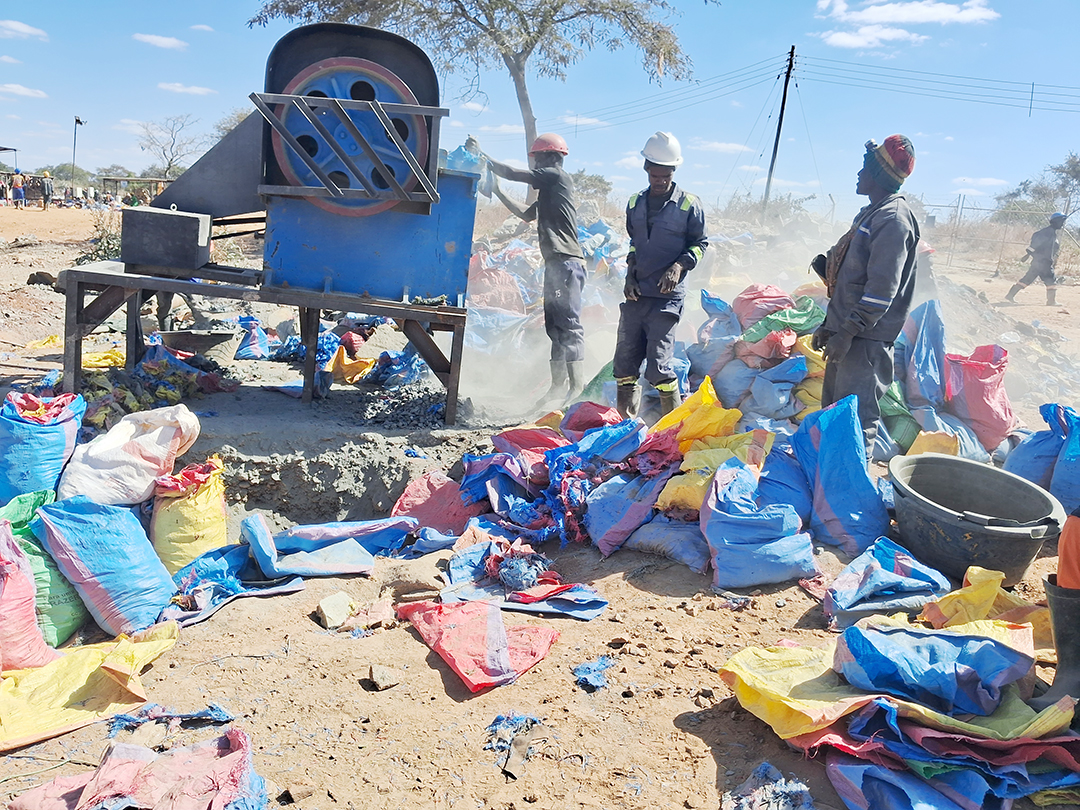
Three miners in hard hats operate a rock-crushing mill at a small-scale gold mining site, with dust rising and sacks of crushed ore piled in the foreground.

Small-scale miners operate a stone crusher at a gold processing site in Chegutu, Zimbabwe. Sacks of crushed ore await panning and washing at one of dozens of informal mining sites in the area, where artisanal miners now produce most of the country's gold. (Image: Thomas Chidamba/ZiMining)

47
VIEWS
Share on LinkedinShare on XShare on Facebook
  • Small-scale miners produced 34.9 tonnes of gold in 2025, nearly three times large-scale output.
  • Chegutu has become a test case for formalizing artisanal mining, with 300 miners trained this year.
  • Mercury use remains widespread, with 96% of sites still relying on the toxic metal.

YOU hear this town’s mining belt before you see it.

Stone crushers grind rock into powder, diesel generators hum under acacia trees, and by the time the settlement comes into view, the “quiet” bush has revealed itself as a small, loud factory built from dust and sweat.

Under patched tarpaulins, men sort crushed ore by hand. Women swirl water and gravel in metal pans, watching for flecks of gold. Teenagers feed rock into jam tables, eyes fixed on black sand for a telltale glint.

This is Chegutu’s small-scale gold belt, about 105 kilometres west of Harare, one of dozens of pockets across Zimbabwe where informal miners now dig up more gold than the country’s big mining companies.

Small-scale miners delivered 34.9 tonnes of gold to Fidelity Gold Refinery in 2025, compared with 11.8 tonnes from large-scale companies, according to the refinery’s own figures. That helped push Zimbabwe’s total gold output to a record 46.7 tonnes last year, generating roughly $4.6 billion in export revenue.

The Zimbabwe Miners Federation, which represents small-scale operators, is now targeting 45 tonnes from artisanal miners alone in 2026.

Government and industry estimates put the number of registered small-scale gold miners at roughly 500,000, with close to two million Zimbabweans depending on the trade for their livelihoods. Nine in 10 miners still work without secure claims to the land they dig, federation president Henrietta Rushwaya has said.

The old idea that mining is men’s work does not hold here. Women feed the crushers and pans, and young people haul water, feed the mills and watch the jam tables.

“Two years ago, I buried my husband and thought my life was buried with him,” said Mai Tariro, a widow with three children who took up panning on a neighbor’s advice. “Since then, the bush has been my employer. It pays my rent. It keeps my children in school.”

Vimbai Pekeshe, another panner, said the work has given women a say they did not have before. “Before, we sat at home waiting for money that never came. Now we decide,” she said. “My daughter is in Form 4 because of this dust.”

Research on the region backs up what the two women describe. Women make up an estimated 40% to 50% of Zimbabwe’s artisanal mining workforce, one of the highest shares in Sub-Saharan Africa. Most, however, remain in lower-paid jobs such as carrying ore and washing gravel rather than owning claims or supervising crews.

A 2025 study by the Tariro Youth Development Trust also documented widespread gender-based violence against women in mining communities, and pointed to weak legal protection for them on site.

For 18-year-old Pride Jesinawo, the appeal is simpler: a wage his friends in town cannot find. “Some nights we do not sleep, hauling water, moving stones, grinding ore, panning till our backs ache,” he said. “My friends in town are still looking for jobs. I already have one. I’m saving for college fees.”

Zimbabwe’s official unemployment rate looks low on paper, estimated at under 9% by the International Labour Organization. Independent labor studies put the share of workers in informal jobs, including artisanal mining, at around 80%, a gap that helps explain why young Zimbabweans keep choosing the pits over the job hunt.

Chegutu has become something of a showcase for the government’s push to bring order to the sector. In May, 300 small-scale miners graduated from a state-backed training program funded by Mutapa Gold Resources and run with Magaya Mining and the Zimbabwe School of Mines.

Mines and Mining Development Minister Polite Kambamura told the graduation ceremony the sector’s status has changed. “This sector is no longer peripheral,” he said.

At a nearby Magaya Mining processing site, chief executive Zweli Lunga said tighter security and formal work have cut the violence that once plagued the area. “Everybody has time to work and make money,” he said, describing a shift away from the fights that used to break out among rival crews.

The company is also testing carbon-in-leach processing, a method it says can recover gold without mercury, a break from the norm across most of Zimbabwe’s small-scale sites.

Mercury remains the industry’s biggest health and environmental hazard. Zimbabwe’s Environmental Management Agency estimates small-scale miners use more than 50 tonnes of mercury a year to separate gold from ore. This is despite the country’s 2021 ratification of the Minamata Convention, a global treaty aimed at cutting mercury use.

A United Nations Environment Programme review found 96% of artisanal gold-processing sites in the country still rely on the toxic metal, and researchers have found women and children living near mining sites are especially at risk.

EMA spokesperson Amkela Sidange said the agency struggles to stop the trade in smuggled mercury, calling itself “aware of the continued clandestine illegal importation of mercury” and describing enforcement as a challenge that requires cooperation across government agencies.

Beyond mercury, studies of Zimbabwe’s artisanal miners have found high rates of workplace accidents and disease. One survey of more than 400 miners found accident and injury rates above 25%, driven mainly by mine collapses, blasting and long shifts.

Another study of nearly 4,000 miners recorded silicosis in 19% of cases and HIV in 18%, reflecting cramped, dusty conditions and limited access to health care.

By law, all gold mined in Zimbabwe must be sold to Fidelity Gold Refinery, a state-owned company that holds a monopoly on gold buying and export. Miners can sell at any of its buying centers around the country and are typically paid on the spot, once the gold’s weight and purity are checked.

Since 2024, small-scale miners have kept 100% of their export proceeds and no longer pay value-added tax on gold delivered to the refinery, changes meant to discourage smuggling, which authorities say still costs Zimbabwe close to $2 billion a year.

Since May 2026, small-scale gold mining has also been reserved for Zimbabwean citizens and fully Zimbabwean-owned companies, with foreign operators required to shift into large-scale mining or shut down by January 2027.

Back at the crushers, veteran miner Jimmy Sakani leaned over a teenager working the jam table, coaching him the way he was once coached. “Watch the black sand, mwanangu,” he said. “Gold does not float. If you hurry, you lose it.”

Government officials and mining executives are betting that patience, paired with formal training, shared processing centers and mercury-free technology, can turn Zimbabwe’s artisanal gold rush into a lasting industry rather than a boom that burns out.

For now, in Chegutu, the crushers keep turning from sunrise to dusk, one pan of gravel at a time.

Tags: Africa EconomyArtisanal MiningchegutuFidelity Gold RefineryGold MiningMercury PollutionMining safetyWomen in MiningYouth UnemploymentZimbabwe
ZiMining

ZiMining

Related Posts

Engineer Charity Chenai Chigwada receives an award at the Zimbabwe Institution of Engineers Annual Dinner.
Company News

Chigwada receives two engineering awards

by ZiMining
August 12, 2026
Researchers working on rehabilitated waste-rock dumps at a mine in Namibia.
Commentary & Analysis

Mining’s value should outlast the ore body

by Jeremiah Ndhlovu
August 11, 2026
Miner inspecting a rock face underground in a mine.
Events & Conferences

ZINIRE seeks papers on technology and mine safety

by ZiMining
August 11, 2026

Leave a Reply Cancel reply

Your email address will not be published. Required fields are marked *

I agree to the Terms & Conditions and Privacy Policy.

Search ZiMining

No Result
View All Result

Most Read

  • Zimbabwe Mines Minister Polite Kambamura seated at a desk with the national flag behind him.

    Zimbabwe suspends raw mineral, lithium concentrate exports with immediate effect

    0 shares
    Share 0 Tweet 0
  • Goriwondo advocates engineer-led reforms at ZIE leadership

    0 shares
    Share 0 Tweet 0
  • Zimbabwe tightens grip on lithium exports, demands local processing push

    0 shares
    Share 0 Tweet 0
  • Zimbabwe explains rules for mineral exports

    0 shares
    Share 0 Tweet 0
  • Retrenched diamond workers ask state to recover unpaid pensions

    0 shares
    Share 0 Tweet 0

Latest from ZiMining

Three miners in hard hats operate a rock-crushing mill at a small-scale gold mining site, with dust rising and sacks of crushed ore piled in the foreground.

Chegutu’s small-scale miners now power Zimbabwe’s gold boom

August 13, 2026
Engineer Charity Chenai Chigwada receives an award at the Zimbabwe Institution of Engineers Annual Dinner.

Chigwada receives two engineering awards

August 12, 2026
Researchers working on rehabilitated waste-rock dumps at a mine in Namibia.

Mining’s value should outlast the ore body

August 11, 2026
Miner inspecting a rock face underground in a mine.

ZINIRE seeks papers on technology and mine safety

August 11, 2026
Aerial view of Caledonia Mining's Blanket Gold Mine in Zimbabwe. Title

Caledonia profit rises as Blanket gold output recovers

August 11, 2026
ZiMining

ZiMining is Zimbabwe's independent voice for mining, energy and natural resources.


We deliver factual reporting on policy, commodities, and critical minerals across Africa and global markets.


Subscribe to Market Brief

Work With Us

  • Careers
  • Advertise With Us
  • Supplier Directory
  • Submit Press Release
  • Market Brief Newsletter
  • Media Kit

Top Sections

  • Gold
  • Platinum & PGM
  • Critical Minerals
  • Policy & Regulation
  • Markets & Business
  • Company News
  • ESG Reporting
  • Sustainability

Company

  • About Us
  • Contact / Advertise
  • Magazines
  • Donate to ZiMining

© 2025 ZiMining - Exclusively Mining | Privacy Policy | Terms & Conditions

Welcome Back!

Login to your account below

Forgotten Password?

Retrieve your password

Please enter your username or email address to reset your password.

Log In
ZiMining Donation Banner
ZiMining

News without an agenda.

ZiMining is an independent publication with no corporate parent, no shareholders and no government influence. Our mission is journalism, not profit margins. Your donation supports independent reporting that serves the mining industry across Africa.

ZiMining Sliding Donation Card
No Result
View All Result
  • News
    • Breaking News
    • Editor’s Picks
    • Company News
    • Exploration & Discovery
    • Production & Operations
    • Zimbabwe
    • Global
  • Commodities
    • Gold
    • Copper
    • Lithium
    • Critical Minerals
    • Platinum Group Metals
    • Diamonds
    • Coal
  • Regions
    • Zimbabwe
    • Southern Africa
    • West Africa
    • East Africa
    • Central Africa
    • Global
  • Markets
    • Prices & Data
    • Mining Stocks
    • Companies
    • M&A & Deals
    • Finance & Investment
    • Junior Miners
  • Technology
    • Innovation & Technology
    • Automation & Robotics
    • AI & Data Analytics
    • Digital Mining
    • Equipment & Machinery
    • Safety Technology
  • Sustainability
    • Environment & Climate
    • Community Impact
    • ESG & Reporting
    • Decarbonisation
    • Water & Land Use
    • Women in Mining
  • Policy
    • Government & Regulation
    • Government & Policy Makers
    • Legislation & Compliance
    • Trade, Tax & Royalties
    • Risk Management
    • Artisanal & Small-Scale Mining
  • Insights
    • Editorials
    • Contributors
    • Commentary & Analysis
    • Blasted Zone
    • Industry Leaders
    • Special Reports
    • ZiMining Magazine
    • Events & Conferences
    • Research & Reports

© 2025 ZiMining - Exclusively Mining | Privacy Policy | Terms & Conditions

This website uses cookies. By continuing to use this website you are giving consent to cookies being used. Visit our Privacy and Cookie Policy.
Not enough quota to unlock this post
Unlock left : 0
Are you sure want to cancel subscription?