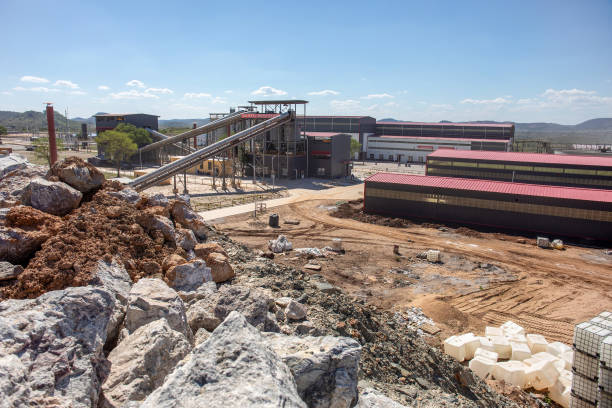
- Zimbabwe fast-tracked its lithium export ban after illicit stockpiling was found in Mozambique.
- Only one of Zimbabwe’s seven major lithium producers has a working sulphate plant.
- Congo’s cobalt export suspension pushed prices up 105% in eight months.
- CMAG says export bans can create leverage, but cannot build industrial capacity alone.
ZIMBABWE’S government suspended raw lithium exports in February, eleven months ahead of schedule, after officials found lithium had been stockpiled illicitly at the Port of Beira in Mozambique.
Information ministry spokesperson Nick Mangwana called it “the plunder of our national heritage.” He said it was “a direct undermining of our sovereignty and our collective economic future.”
A new report by the Critical Minerals Africa Group (CMAG) uses cases like this to make a wider point. Export bans can force change, the report says, but they cannot by themselves build the plants, power lines and skills needed to process what stays behind. CMAG studied four countries, namely Zimbabwe, the Democratic Republic of Congo, Namibia and Malawi.
Zimbabwe moved faster than Its plants could
Zimbabwe supplies about 15% of China’s lithium concentrate imports. But by the middle of this year, only one of the country’s seven major lithium producers had a working sulphate plant, Zhejiang Huayou Cobalt’s Arcadia mine.
Sinomine’s Bikita facility and Sichuan Yahua’s Kamativi plant were still under construction. Power shortages and a lack of sulphuric acid held up the work, the report said.
In June, Lithium Association of Zimbabwe chairman Innocent Rukweza asked government for a six-month extension to the original January 2027 export deadline. He told the Chamber of Mines’ annual conference in Victoria Falls that six of the country’s seven producers were not ready.
Workers have also felt the strain as Bikita Minerals cut production and jobs in 2024, citing poor infrastructure and inconsistent licensing rules.
The Zimbabwe Diamond and Allied Minerals Workers Union welcomed the export ban. “This policy direction is consistent with broader African efforts to move away from exporting unprocessed minerals,” general secretary Justice Chinhema said.
Chinhema’s separate concern is conditions inside Chinese-run lithium mines. He said close to 5,000 workers face short-term contracts and weak safety standards, which he called “a wave of colonisation.”
CMAG’s conclusion on Zimbabwe was, “Regulation can outrun infrastructure,” the report said.
Congo shows what market power can do
The DRC suspended cobalt exports for four months from February 2025 to manage a global oversupply. Cobalt prices on the London Metal Exchange rose 105% during the suspension, from about $21,167 a tonne to $43,541 by October.
Congo can do that because it dominates global cobalt supply. Zimbabwe does not yet dominate any single mineral in the same way.
Congo has also shifted its export mix. Cobalt ores and concentrates fell from 60-74% of export volumes in 2014-16 to around 7% by 2022. Unwrought cobalt and mattes rose to more than 90% over the same period.
Ownership, however, has not shifted at the same pace, the report said. Chinese entities hold significant stakes across Congolese mining operations, controlling more than 75% of global cobalt refining capacity.
“Market power can create leverage,” the report said. “Ownership, refining depth and industrial capability determine how much of the resulting value remains in-country.”
Namibia and Malawi took different paths
Namibia published a national beneficiation strategy in 2021, two years before introducing export limits on lithium, cobalt, manganese, graphite and rare earths in 2023.
Investor appetite held up and Namibia had 588 active mineral exploration permits by early this year. High power tariffs and a shortage of metallurgists remain the main constraints, the report said.
Malawi imposed an economy-wide restriction on all raw and unprocessed minerals in October 2025. Unlike Congo or Zimbabwe, Malawi does not dominate global supply of any covered mineral.
CMAG said it is too early to judge Malawi’s case because no comparable price shock has occurred. The report called for the restriction to be “sequenced with investment, infrastructure and production growth.”
Across all four countries, the report said a falling share of raw exports is not proof a restriction is working. “Success is value capture, not simply fewer raw exports,” CMAG said. “The test is whether production moves sustainably downstream, and how much of the resulting economic value remains domestically.”