A new book is set to change how mining companies, workers and unions handle workplace disputes in Zimbabwe — by helping them understand the law before trouble starts.
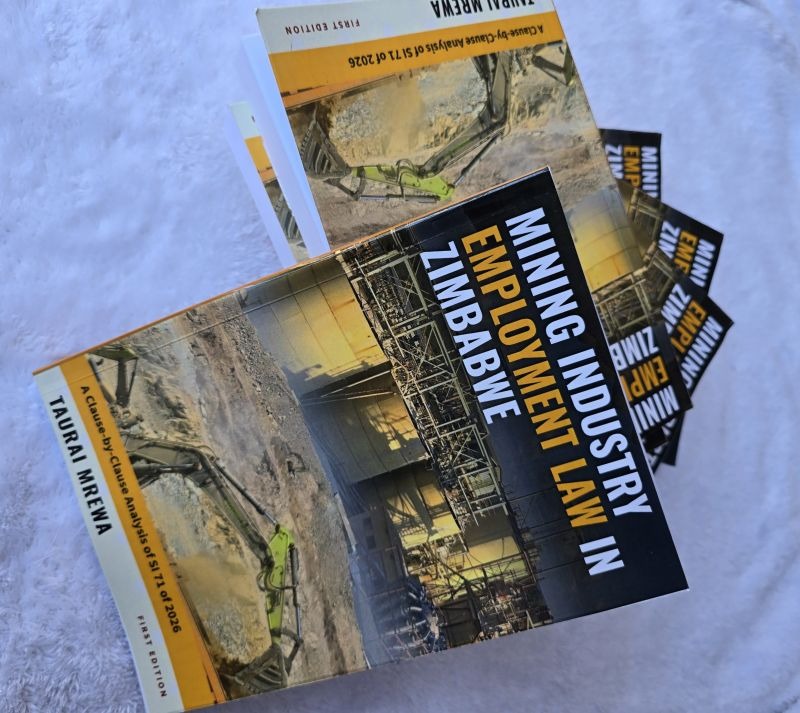
Titled Mining Industry Employment Law in Zimbabwe, the 390-page guide has been written by Bulawayo lawyer Taurai Mrewa and unpacks the country’s revised mining-sector labour rules in plain, practical detail.
At the heart of the book is the mining industry’s new Collective Bargaining Agreement, gazetted in April 2026 as Statutory Instrument 71 of 2026.
The agreement overhauled employment regulation in the sector, leaving many employers and workers unsure of where they stand.
Mrewa says that uncertainty is exactly what pushed him to write.
Too often, he argues, people only look for the law when they are already in trouble — an employer facing a dispute, a worker hauled before a disciplinary hearing, or a union fighting a workplace battle.
“The answer should not be to wait for a dispute, then scramble for the law,” Mrewa said.
“If employers and employees understand the rules upfront, many problems can be avoided altogether.”
To build that understanding, the book goes deep into the new framework.
It examines more than 300 clauses of the Collective Bargaining Agreement and leans on over 100 decided court cases to show how the law has actually been applied in practice.
Before publication, the manuscript was peer-reviewed by four professionals.
One of them, Gladys Mpemba, Principal Labour Consultant at NCS Labour Relations and Training Consultants, said the book arrives at a critical moment for the industry.
She described Statutory Instrument 71 of 2026 as a historic modernisation of the human side of mining, and said Mrewa’s analysis guides readers through the new legal landscape with clarity.
For her, the book is not just for lawyers — it is a definitive resource for anyone with a stake in the future of African mining.
Mrewa shares that view. He says his goal is not simply to explain legislation, but to help workplaces prevent conflict, cut down on expensive litigation, and build a culture of compliance rather than evasion.
That message was on display at the Labour Briefing hosted by the Institute of People Management of Zimbabwe (IPMZ) on 23 October 2026, where he urged human resources professionals to read, understand and apply labour law in their daily work — not just when a case lands on their desk.
The book is aimed at a wide audience: mining companies, employees, HR practitioners, trade unions, labour consultants and legal practitioners.
It will be officially launched in Bulawayo on 27 November 2026, followed by a Harare launch on 4 December 2026.
For Mrewa, the timing matters. With a new agreement now in force, he believes knowledge is the best protection for both business and workers — and the cheapest way to keep Zimbabwe’s mines productive, fair and dispute-free.